
26 Feb 2026
Leadership development is an investment

Leadership development is an investment
Why you need to stop treating leadership development like a perk
I have always thought that leadership capability and alignment was a significant change lever for an organisation. Its sits alongside other levers of culture, vision and strategy
Another way of putting it is that Leadership is part of the operating system of your organisation.
Yet across New Zealand and Australia, leadership development is still treated as discretionary. When pressure rises, it pauses. When margins tighten, it shrinks.
That would make sense if leadership had marginal impact.
It doesn’t.
Under-developed leadership capability quietly drives turnover, disengagement, burnout, safety risk and stalled strategy execution. The cost sits in other budget lines, so we pretend it lives somewhere else.
The real financial question is not whether we can afford leadership development.
It is how long we can afford the compound cost of under-developed leaders.
The Hidden Cost of “Results at Any Cost”
Most organisations believe they value leadership. Fewer are honest about what they reward. Many still operate at a maturity level where results matter more than how results are achieved.
We have all seen it. The high performer who hits the numbers but leaves a trail of disengagement behind them. The technically brilliant leader who creates churn, fear or silence. The executive who delivers short-term profit while eroding long-term capability.
And too often, we look the other way.
The collateral damage rarely appears on a quarterly dashboard. But it shows up later — in attrition spikes, culture surveys, mental health claims, stalled collaboration and loss of trust.
In New Zealand, the average cost of hiring a new employee sits around NZD $25,000. In Australia, replacement costs commonly range from 50% to 150% of annual salary. Research consistently links ineffective leadership to roughly one-third of voluntary turnover.
In a 1,000-person organisation, reducing avoidable attrition by just 5% can equate to more than $1 million annually added to the bottom line.
That is not soft. That is structural.
Organisational maturity is not just about hitting numbers. It is about achieving results while building confidence, capability and trust in the system.
I appreciate that Mantle has a bias and agenda here. Yes, on behalf of New Zealand and Australia we would like to see a greater investment in impactful leadership development here.
I don’t think it is hard to argue that we could use more and better leaders to help us all navigate the current turmoil, volatility and load!
Why We Still Under-Invest
If the case is this clear, why does under-investment persist?
It is not just a cost mindset issue.
We Still Believe Leadership Is Innate
Despite decades of research, many organisations operate on a quiet assumption: some people have leadership; some do not.
High performers are promoted and expected to “just know” how to lead.
When they struggle, we attribute it to personality rather than preparation.
The evidence does not support this belief. Leadership behaviour is learnable. It is shaped by mindset, feedback, deliberate practice and system reinforcement.
But myths are easier than investment.
Urgency Hijacks Importance
Neuroscience tells us the brain is wired to prioritise immediate threats. The urgency of today’s problem activates stress responses that narrow focus to short-term fixes.
There are many areas of modern life we can see this reactivity unintentionally sabotaging things we class as important.
Quarterly pressure feels urgent. Leadership capability feels important — but not urgent.
The brain privileges urgency over importance.
So, we defer development. Again, and again.
But capability compounds slowly, like interest. When neglected, its absence compounds too.
The Training and Development Industry Has Earned Some Scepticism
Executives are right to be cautious.
Years of generic, event-based training have conditioned organisations to equate leadership development with workshops, personality profiles and good intentions.
Too much activity. Too little measurable shift.
As an industry, we need to own this.
If development is not linked to behavioural metrics, engagement data, retention shifts or performance outcomes, it should be in my mind questioned.
As practitioners we should be more confident of the impact we can facilitate. Leadership development must be held to the same standard as any capital investment.
The Neuroscience Makes This Hard to Ignore
Leadership behaviour has outsized impact because it shapes biology.
The brain constantly scans for threat and reward. When leaders create unpredictability, inconsistency or perceived unfairness, the brain shifts into threat mode. Cortisol rises. Cognitive flexibility narrows. People conserve energy and protect themselves.
Disengagement is not laziness. It is neurobiology.
Conversely, when leaders create clarity, autonomy and fairness, reward pathways activate. Trust increases. Learning accelerates. Innovation rises.
Leadership is not atmosphere. It shapes the cognitive bandwidth available for performance.
And behaviour does not change through insight alone.
Under pressure, leaders revert to conditioned neural habits. One-off workshops cannot rewire those patterns. Sustained practice, feedback and reinforcement can.
You could consider Leadership development as structured habit change.
Immediate and Long-Term Return
There is a misconception that leadership development is a mid to long-term pay off.
Done properly, it should deliver both immediate and sustained return.
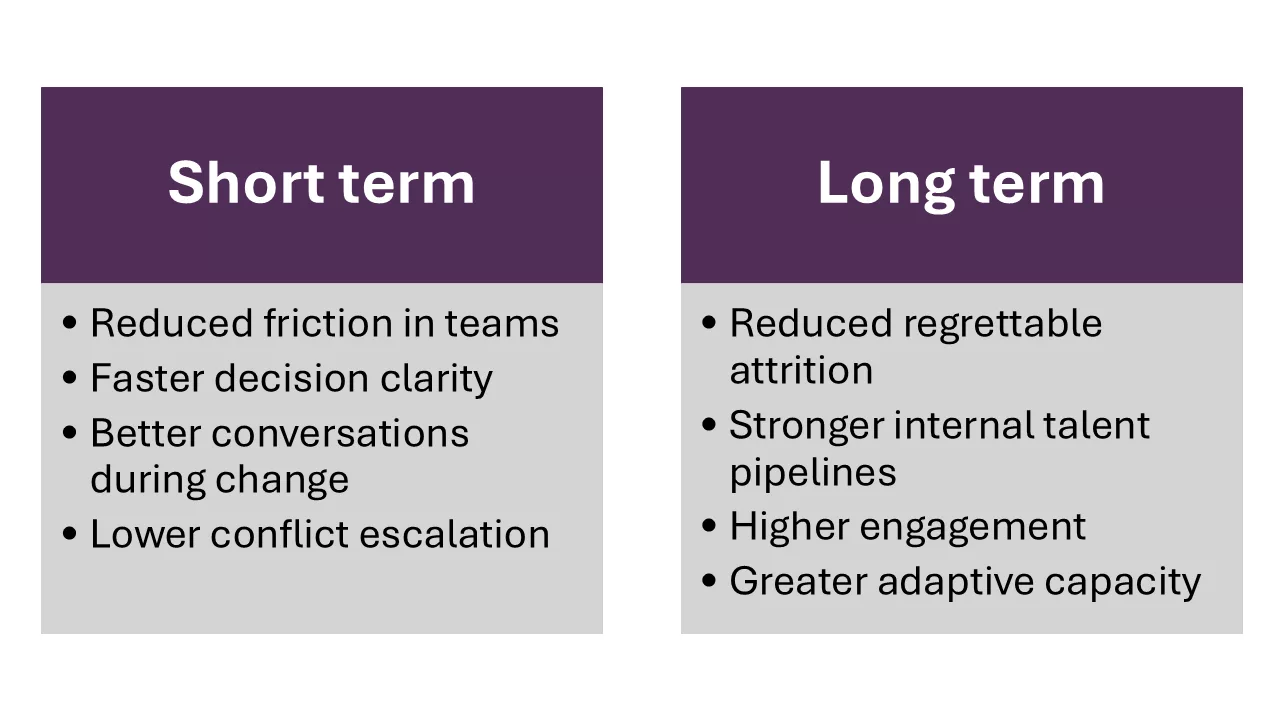
Meta-analyses show leadership development produces meaningful behavioural improvements. Zenger Folkman’s data shows even moving leaders up one effectiveness quartile significantly reduces turnover risk. Well-designed programs aligned to strategy have reported ROI between 250% and 450%.
The issue is not whether return exists.
It is whether we measure it.
Raising the Bar on Measurement
If leadership is infrastructure, it must be designed and evaluated as such.
That means:
– Defining clear behavioural shifts expected
– Linking development to engagement, retention and performance indicators
– Tracking pre- and post-program movement
– Embedding reinforcement in performance systems
At Mantle, we are on this journey ourselves. As an industry, we need to move beyond attendance rates and satisfaction scores.
If leadership development cannot demonstrate behavioural and business impact, it will remain vulnerable to budget cuts.
If it can, it becomes non-negotiable.
The Strategic Choice
In volatile environments, it is easy to be hijacked by the urgent.
It is harder to invest in the important.
But leadership capability is not optional infrastructure. It is the operating system through which strategy, culture and performance run. Results at any cost is a low-maturity model. Results while building confidence and capability is a higher one.
The difference shows up in resilience, trust and long-term value.
Leadership compounds.
So does neglect.
The question is not whether we can afford to invest.
It is whether we are prepared to keep paying the hidden bill of not doing so
Curious?
Are you seeing “results at any cost” leadership create hidden damage in your organisation?
How are you measuring leadership impact beyond attendance and satisfaction scores?
Like to know more about how to use practical neuroscience to drive more impact?
Register for one of our public leadership Programmes. Leadership Collective – Mantle
Connect with us on LinkedIn, or sign up to our e-newsletter